Stages — When an Event Changes Shape
The idea
Most events are one shape the whole way through: four rounds of Stableford, add up the points, done. A club championship is not. It plays 36 holes of stroke play to find its best four players, and then those four settle it head to head — and the stroke totals stop mattering the moment the knockout begins.
A stage is a group of rounds whose scores reset at its boundary. Splitting an event into stages is how you say “this part is scored on its own”, so one event can change shape partway through.
Stages are optional, and most events never need one. An event with no stages behaves exactly as it always has.
The event they were built for
Norfolk Golf Club runs its championship the way most clubs do:
- 36 holes of gross stroke play over two days. Every entrant plays.
- The top four advance. Everyone else is finished.
- Two semi-finals — 1 v 4 and 2 v 3, at match play. The losers go out.
- The final — 18 holes between the two survivors.
Three stages: Qualifying, Semi-finals, Final. Nothing exotic — it is roughly how every club championship in the country is run.
Why the score has to reset
This is not just about how it looks. Qualifying is scored in strokes and the knockout is scored in match points, and there is no sum of the two that means anything: four over par plus one match point is not a number. Add them and you would be inventing a result rather than reporting one.
Nothing is ever added across a stage boundary. So the rule about only adding up like with like applies inside each stage rather than over the whole event — which is what lets you run a championship like this at all.
There is no override for this, and no “are you sure?”. If two rounds cannot be added together, they belong in different stages. Which combinations are refused, and why →
What one looks like
Norfolk, played out. The two qualifying rounds add up to the 36-hole total that seeds the knockout; the semi-finals are drawn 1 v 4 and 2 v 3, and their columns are match points. Notice that there is no column spanning all four rounds — there is no number that could go in it.
| Player | Qualified | R1 | R2 | 36 holes | Semi | Final | Finished |
|---|---|---|---|---|---|---|---|
| Duncan | 1st | +7 | +8 | +15 | 1 | 1 | Champion |
| Vaughan | 2nd | +8 | +9 | +17 | 1 | 0 | Runner-up |
| Hamish | 3rd | +9 | +10 | +19 | 0 | — | Lost semi-final |
| Ossian | 4th | +11 | +10 | +21 | 0 | — | Lost semi-final |
| Struan | 5th | +12 | +11 | +23 | — | — | Missed the cut |
Struan qualified one place outside the four and never reached the knockout, so his semi-final and final cells are empty rather than zero. A player who did not play a stage has no score in it — which is a different thing from having scored nothing.
Reading the standings
A staged event shows one stage at a time. The chips across the top of the Standings tab are a selector, not a list of sections: tapping one swaps the whole table for that stage's.
A stage that has finished keeps ranking its whole field, not just whoever is still standing. Once the event has moved on, that table is a result rather than a live view: the club noticeboard lists all 24 in qualifying order, and does not demote the man who qualified first and lost his semi-final three days later.
“So who finished third?”
Once a score resets, there is no sum that answers that question. The two beaten semi-finalists both hold nought match points. The players who missed the cut hold a 36-hole stroke total. Neither number can be compared with the other.
So the event answers it ordinally, on a Final placing view that appears as the last chip once the last stage is signed for — and which a finished event opens on. The order is:
- How far you got. A finalist finishes above a semi-finalist, who finishes above everyone who missed the cut.
- Where you came in that stage. The winner of the final above the loser.
- Where you came in the stages before it, most recent first. This is what separates two beaten semi-finalists — and it separates them the way the club would, on qualifying.
Each row carries the score from the stage it came from, labelled with that stage's name. There is deliberately no combined total, because there is no number that could be one.
Carrying instead of resetting
Not every boundary is a reset. A 72-hole event with a halfway cut keeps the first two rounds' strokes and adds the last two to them — the field shrinks, but the score does not restart. That is a stage with carry switched on.
Carry means “this stage also counts everything the previous one counted”. So a carrying stage reaches back over the rounds before it instead of starting fresh, and an event where every stage carries produces exactly the same numbers as an event with no stages at all.
| Event | Stages | What the last stage counts |
|---|---|---|
| An ordinary trip | None | Every round — the usual behaviour |
| Club championship | Qualifying · Semis · Final | The final only. Each stage stands alone |
| 72 holes with a cut | Days 1–2 · Days 3–4 (carry) | All four rounds, over the players who survived the cut |
| Season with a shootout | League · Finale | The finale only — the leaders start Sunday level |
Who advances is your call
Eagle Sheet does not cut the field for you. You decide who goes through and mark everyone else as eliminated on the Roster tab; each of them is then shown with the round they went out after, and they stop appearing in the stages they did not play.
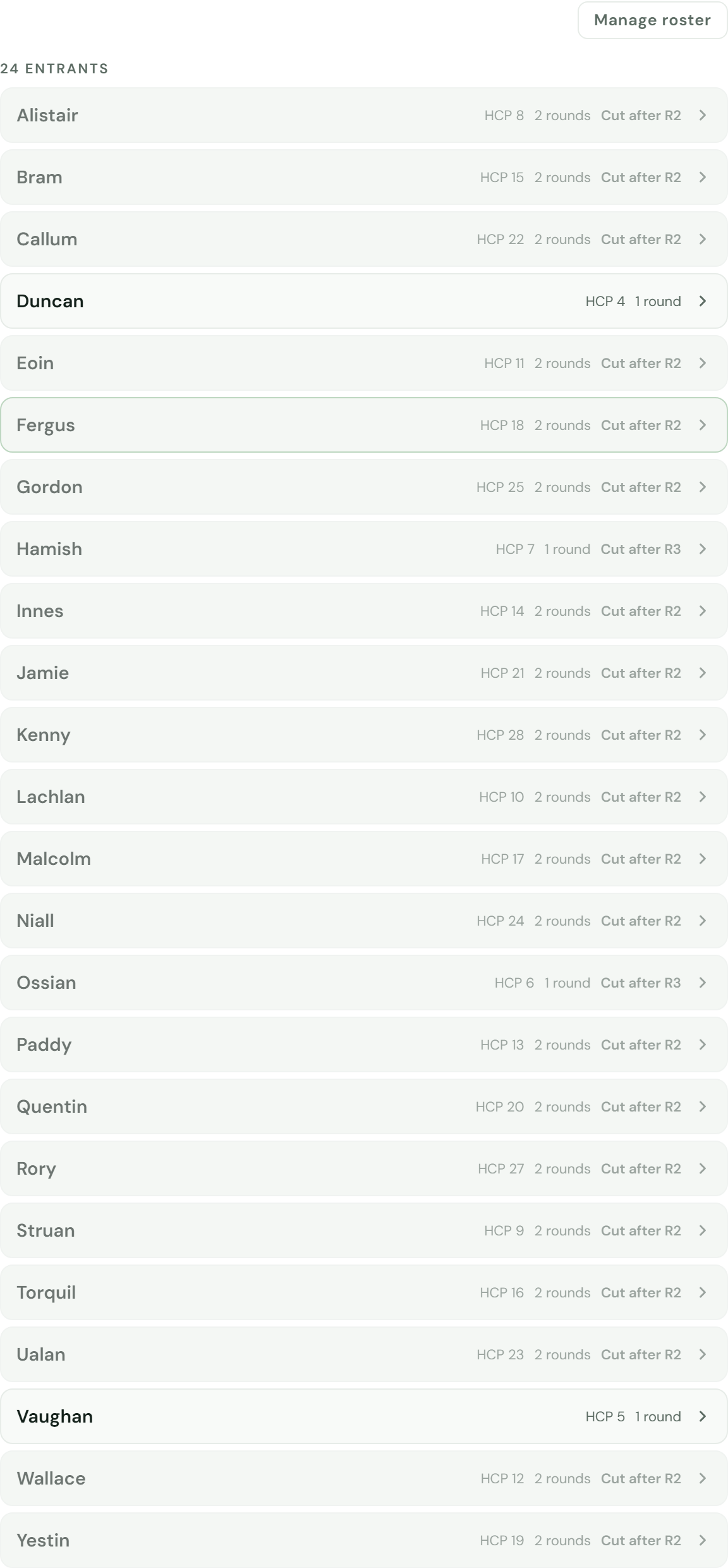
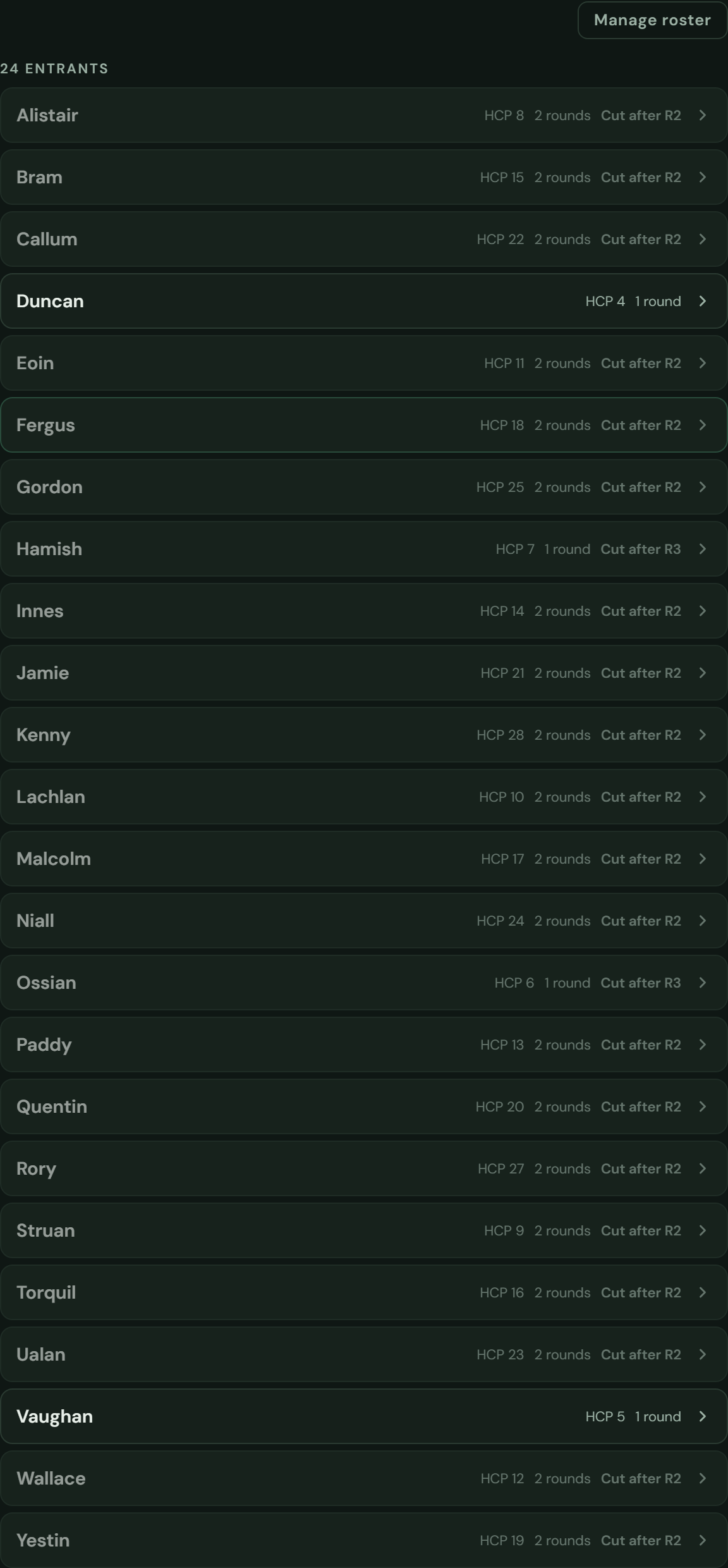
That is the same five players as the ladder above — Struan cut after R2, Hamish and Ossian after R3, Duncan and Vaughan still standing.
Which is what you want, because real events have ties on the cut line, withdrawals, and a committee that occasionally decides something no rule could have predicted. The last call is yours.
Setting them up
Stages live in Settings → Stages on an event you administer, not in the create wizard — most events never need them, and an event that does usually discovers it once the entries are in.
The editor asks one question per stage: where does this stage end? You name the stage and pick the round it finishes on, and everything up to that round belongs to it. It asks that rather than offering a tick-box per round because a stage is always a continuous block of the schedule — so an impossible plan is not something you can draw.
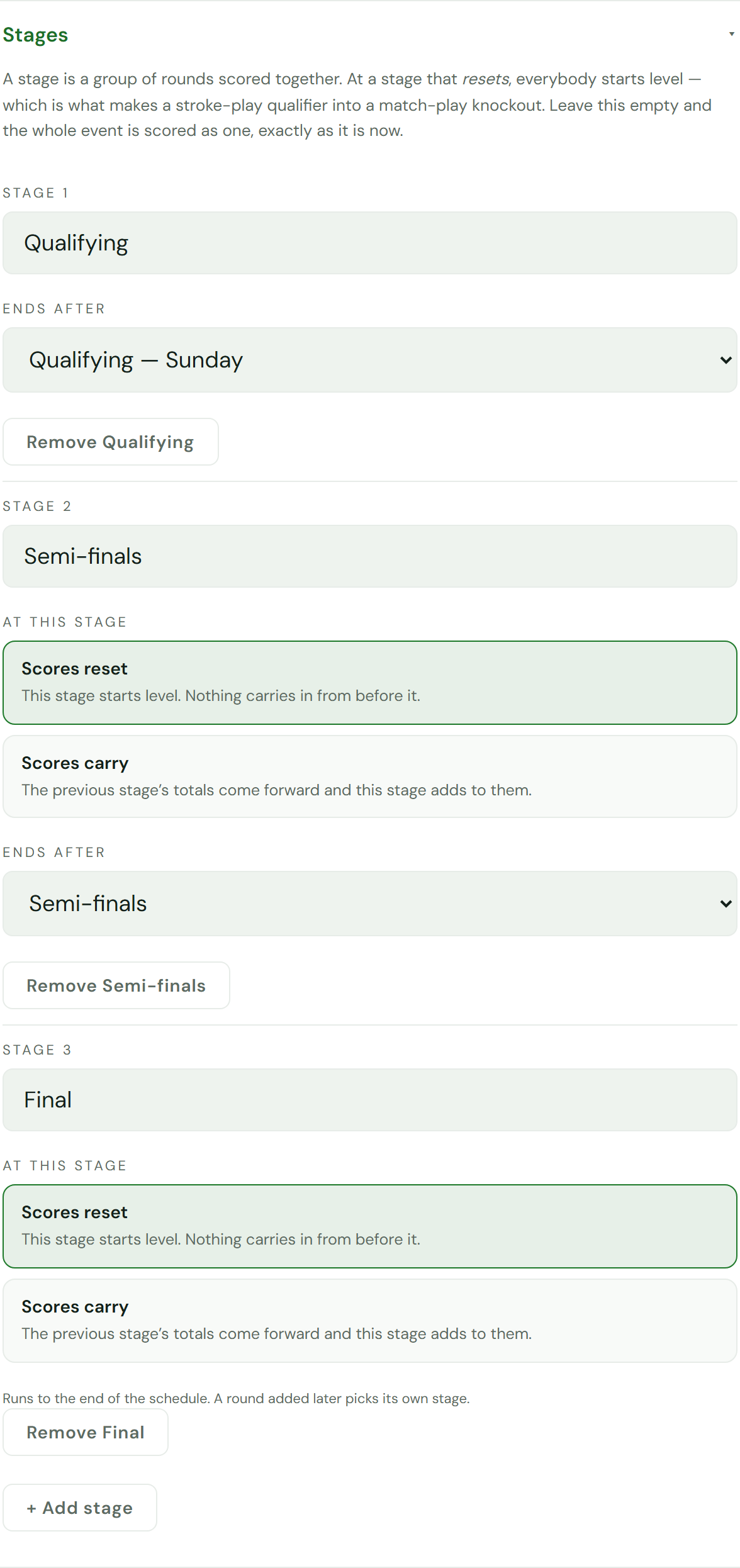
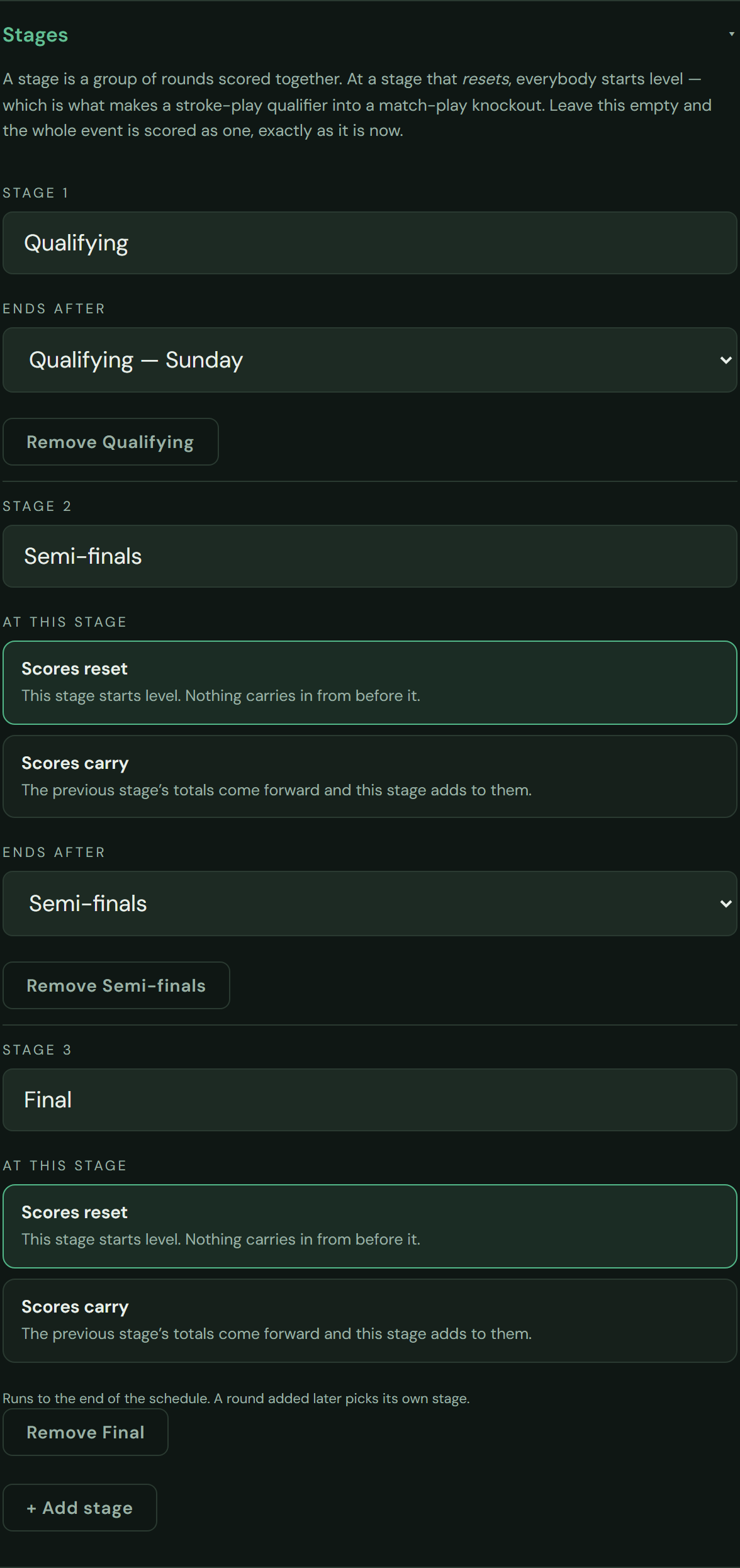
Adding a round later? The Add round sheet asks which stage it joins, offering the stage being played and any empty ones after it. That matters because the format rules are checked against the stage the round is actually joining — so a match-play round can be added to a knockout stage even though the event as a whole also contains stroke play.
Three events to copy
Club championship. Two stroke-play rounds as Qualifying, one round of two match-play boards as Semi-finals, one board as The Final. No carry anywhere. Mark everyone outside the top four eliminated after round 2, and the two beaten semi-finalists after round 3.
72 holes with a cut. Two stages, both stroke play, with carry on the second. Eliminate everyone below the cut line after round 2. The leaderboard keeps counting all four rounds for the players who survive.
Season league with a finale. A long League stage of however many rounds, then a one-round Finale with carry off, so everyone who reaches the last day starts level and the season is decided on the day. Harsh, and extremely popular.
Worth knowing
- Round numbers stay event-wide. Stages group rounds 1–4; they do not renumber them into “stage 2, round 1”. The schedule and the standings always agree about which round is which.
- Scoring settings are inherited. A stage only stores what it changes, so adjusting the event's tiebreak adjusts every stage that had not overridden it. Norfolk overrides nothing at all.
- Deleting a stage merges, it does not orphan. A boundary is a fence: remove it and the rounds either side become one stage. Nothing is left unscored.
- The Rules sheet describes your stages in plain words, written from your own settings — so if a number ever surprises someone, that sheet is the answer.
See it for real: Norfolk Club Championship
A stroke-play qualifier that becomes a match-play knockout. Opens the actual app on an example event — read-only, no account.
Run your event
Build the roster once, add rounds as you go, and send one link to everyone. Only the organiser needs Premium.